Latest articles on Audio Time Travel
LATEST TOPICS


2024.02.13

Audio Time Travel is an article that allows you to enjoy your trip to Osaka while listening to a guide. In this article, you can enjoy a portion of the audio guide. You can experience the entire audio on the ON THE TRIP app.
Sakai was once a port city of such great power that it was even called "Golden Days." But where are the traces of that time? When you get off at Nankai Sakai Station, you may not sense any sign of it. That's because the area around the station was once the sea and was reclaimed land. The coastline and port at that time were located further inland.
On this journey, we will go in search of stories from the golden age of the port city of Sakai. You may discover the unique people who played an active role in Sakai, the intellectual pastime of the tea ceremony, and the hidden stories that lie behind the glorious prosperity.

The path we walked from the station to here was once the sea. The area inland from the coastline indicated in Xavier Park was the city of Sakai at that time. I would like you to climb the stepped seawall and look around. Can you see the difference in elevation?
The Nanban ships brought more than just tableware to Japan. They also brought Christianity. The missionary Francis Xavier stopped in Sakai during his missionary work and stayed at a merchant's house there. The merchant was baptized and turned the tiled building into a church. Some say that Christmas was first celebrated there in Japan.
In Christian mass, there is a ritual in which people pass around wine from the same cup and wipe the part of the cup they have touched with a cloth after each sip. In fact, this ritual has something in common with the tea ceremony. After drinking from it, you wipe the tea utensil with a cloth and pass it to the person next to you. If you trace the origins of the tea ceremony, it is a culture that mixes cultures and religions. It may be a free and rock culture that goes far beyond our imagination.
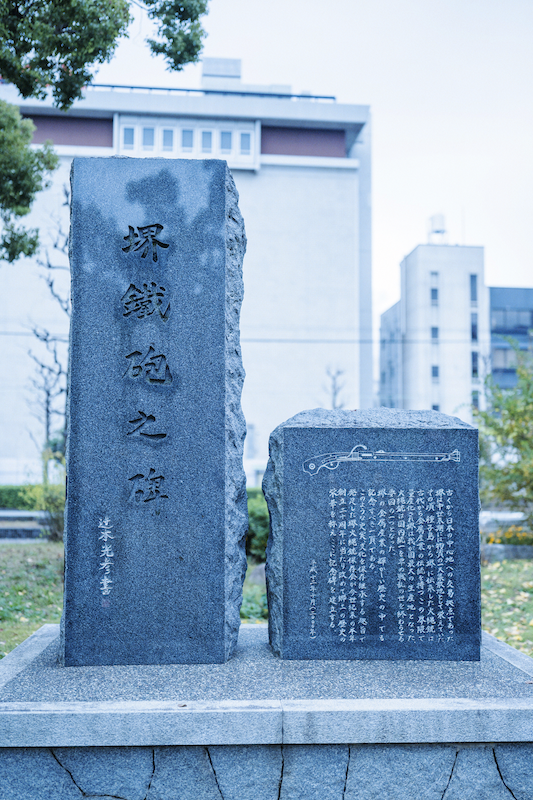
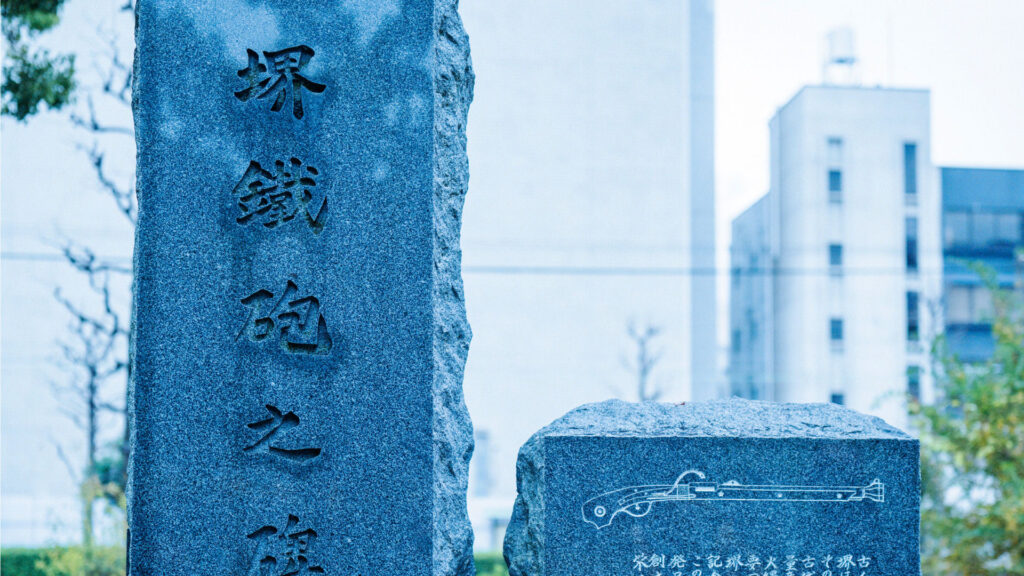
One of the things introduced to Japan from Portugal was the gun. A Portuguese man who was shipwrecked on Tanegashima had two guns with him. A merchant from Sakai purchased one of the guns, which led to the mass production of guns. But how was it possible to mass-produce guns in Sakai? Let's unravel this history by looking at the monument in the park.
Its history dates back to the Kofun period. Sakai was home to craftsmen with the advanced skills to build kofun tombs. These craftsmen gradually acquired the skills to cast metal products using iron and copper, and became a group of engineers. When guns were introduced to Sakai, they were disassembled and craftsmen were assigned to each part to make guns. Thanks to the iron casting techniques and the division of labor system, mass production of even guns that had never been seen before became possible. This is how Sakai became Japan's number one gun production area.
Sakai's golden days were marked by its prosperity as a trading port. However, it cannot be said that these were truly wonderful times. Much of Sakai's wealth came from firearms, and its merchants were also known as "merchants of death" who made their fortunes through weapons. Weapons that kill people attract resentment. The reason for fortifying the city with moats may not only have been to prevent interference from others, but also because people needed to protect themselves.
This guide was created based on documents and interviews and includes some interpretation done by us at ON THE TRIP. Theories differ between experts, so try to find out what really happened on your travels!
Information presented here is current as of 2024. Please check the websites of the individual shops and facilities for up-to-date information on business hours.